Which Adjustable Dumbbell Format Fits a Small Home Gym?
A practical comparison of selectorised, plate-loaded and fixed dumbbell formats for small home gyms, with a focus on storage, adjustment speed, progression and shared-room living.

If your priority is keeping a shared room clear, selectorised adjustable dumbbells are usually the best choice: one pair can cover multiple training weights while occupying roughly the footprint of its storage tray. Choose plate-loaded adjustable dumbbells when lower upfront cost, simple parts and flexible loading matter more than quick changes. Choose fixed hex dumbbells when you value immediate use, stable floor handling and straightforward training more than compact storage.
The important point is that “adjustable” is not automatically synonymous with “best.” In a small home gym, the right format depends on how often you change weights, how strong you expect to become, whether someone else uses the room and how much tolerance your household has for loose plates or equipment left out between sessions.
Start with the room, not the maximum weight
Before comparing mechanisms, decide where the dumbbells will live. A small home gym might be one corner of a bedroom, a section of a lounge or a shared spare room. In each case, equipment has to do more than fit during a workout: it needs a place to sit safely when the workout is over.
A useful test is to mark out your intended storage area, then picture the whole routine. Can you remove the dumbbells from storage without moving furniture? Is there enough clear floor around you for presses, squats, rows and hinges? Can you put the weights down without blocking a door, damaging flooring or creating a trip hazard? If the answer is no, a supposedly compact set may still make the room feel crowded.
Also consider the path between storage and exercise space. A pair of adjustable dumbbells stored under a sofa may be tidy, but less practical if you need to drag out a tray, move cushions and reset the room every time you train. The best compact setup is often one that is easy enough to use several times a week.
Selectorised adjustable dumbbells: best for minimal storage
Selectorised dumbbells use a dial, pin, lever or similar mechanism to choose a load. The selected handle lifts from a cradle with the required weight sections attached, while unused sections remain in the tray. For many people, this is the most convincing answer to the small-space problem.
The main advantage is speed. You can move from lighter shoulder work to heavier rows without handling separate plates. That makes selectorised systems especially useful for full-body sessions, supersets and routines where each exercise needs a different load. Their storage is also contained: the dumbbells and spare weight sections normally live in one defined place rather than spreading across the room.
There are trade-offs. These systems tend to be more mechanically complex than basic handles and plates. You need to return the dumbbell carefully to its tray before changing weight, keep the selection mechanism clear of dust and check that the chosen setting is fully engaged before lifting. They can also feel longer or bulkier than a fixed dumbbell at higher settings, which some people notice during curls, presses or movements where the ends come close to the body.
Selectorised sets work best for the person who wants variety without visual clutter. They are less ideal for fast-paced training with two people, since one pair cannot be set to two different weights at the same time. They may also be less convenient if you regularly drop dumbbells after demanding sets; controlled placement is the sensible expectation in a home setting regardless of format.
Plate-loaded adjustable dumbbells: best for flexibility and simpler hardware
Plate-loaded adjustable dumbbells use handles, removable plates and collars. Some accept standard plates you may already own; others use proprietary plates designed for their handles. They often appeal to home exercisers because the basic idea is familiar and the separate components can be replaced or expanded more easily than a sealed selectorised system.
This format can offer good progression. You can increase load in relatively small steps if compatible plates are available, and a pair of handles can cover a broad range. It can be a practical option if you also use weight plates for a barbell, although sharing plates means more setup and may leave other equipment unavailable during a session.
Its weakness in a shared room is the number of loose parts. Plates need storage, collars need a predictable home and changing weights means placing items on the floor or a nearby surface. This is manageable with a compact vertical plate tree, a low storage box or a dedicated shelf, but it is less tidy than a selectorised tray. A rushed weight change can also interrupt the flow of a workout.
Handling deserves attention too. Depending on the design and amount of loading, plate-loaded dumbbells can be longer than fixed dumbbells. Check that collars are secure before every set and avoid relying on furniture or soft flooring as a place to assemble them. If you train early or late while others are nearby, take extra care when setting plates down.
Fixed hex dumbbells: best for speed and everyday simplicity
Fixed dumbbells are not adjustable, but they remain an important comparison point. A single pair is the easiest format to understand: pick it up, train and put it back. There are no dials, trays, collars or plate stacks to manage. That simplicity can be valuable in a busy household, particularly for short sessions squeezed between work and family commitments.
Hex-ended dumbbells are often especially practical for home use because the flatter sides help limit rolling when they are placed on the floor. A rubber outer layer may also be preferable to bare metal in a shared living environment, though it does not remove the need for care, controlled placement and appropriate floor protection.
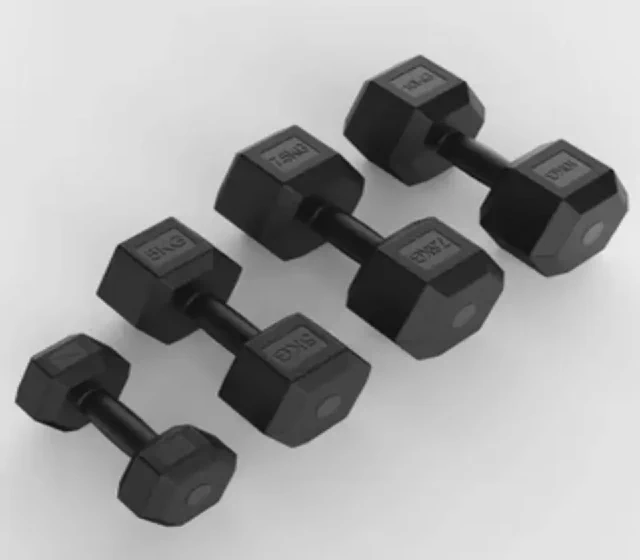
Commercial Eco Cement Core Hex Dumbbells, Low Noise Shock-Absorb Rubber Encased Anti-Roll Weights for Gym Studio Strength Gear
- MIC category
- Dumbbell
This supplier listing presents a cement-core, rubber-encased hex dumbbell with low-noise, shock-absorbent and anti-roll claims. It represents the fixed-weight route: less compact than one adjustable pair across a full range, but immediately ready for a single-weight workout.
Best for People who want a straightforward fixed-weight option for controlled strength sessions and do not need to change loads repeatedly.
- Hex-shaped format is presented as anti-roll
- Supplier listing describes a rubber-encased construction
- No adjustment or separate plate handling during a session
Confirm before inquiry: The low-noise and shock-absorbent descriptions are supplier-listing claims. Confirm the available weight, dimensions, floor protection needs and ordering details directly before purchase.
The limitation is progression. One fixed pair gives you one load. That can be enough for beginners, rehabilitation-style work guided by a qualified professional, carries or accessory exercises, but it becomes restrictive as your strength and exercise selection change. A useful fixed-dumbbell collection may require several pairs, and that means a rack or a carefully planned storage zone.
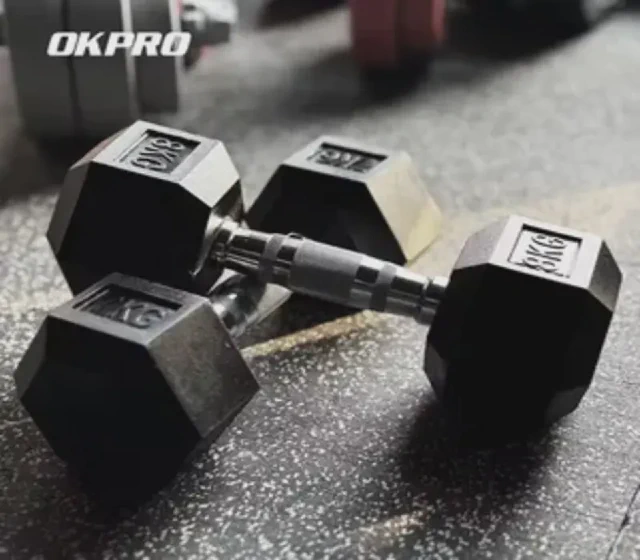
Okpro Factory Wholesale Strength Training Free Weights Rubber Lbs Gym Hex Dumbbell
- MIC category
- Dumbbell
Listed as a rubber hex gym dumbbell, this is a conventional fixed-weight format rather than an adjustable system. Fixed pairs are useful as a benchmark: they trade storage efficiency for instant pickup-and-go use, especially when exercises move quickly from presses to rows or carries.
Best for Home exercisers who value fast transitions, predictable handling and a dedicated weight for regularly repeated movements.
- Fixed-weight design avoids adjustment steps
- Hex form can be more stable on the floor than round ends
- Rubber hex format suits comparison with compact adjustable systems
Confirm before inquiry: This is a supplier listing in the Dumbbell category, not an independent performance review. Check the precise weight range, handle dimensions and finish specifications with the supplier.
For that reason, fixed dumbbells make the most sense in a small room when you deliberately keep the collection narrow: perhaps one versatile pair, or two pairs chosen for distinct purposes. They are also a strong companion to an adjustable pair when you want one frequently used weight permanently ready.
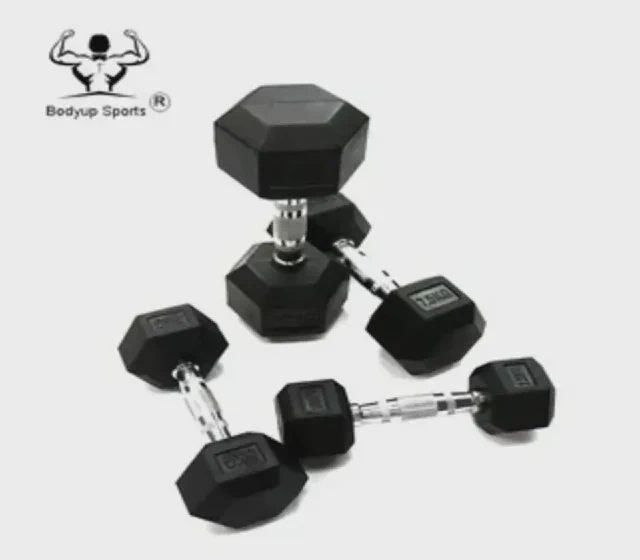
Rubber Hex Dumbbell for Training Gym Commercial Fitness Equipment
- MIC category
- Dumbbell
This rubber hex dumbbell listing is relevant for people deciding whether an adjustable system is necessary at all. A fixed rubber hex pair can be easier to store safely on a small low rack or mat, but building a useful progression range requires multiple pairs and therefore more room.
Best for Those who prefer uncomplicated equipment and have space for one or several dedicated dumbbell pairs.
- Fixed format is ready without changing settings
- Hex-ended shape is practical for floor storage between sets
- Rubber hex construction is a familiar gym-style option
Confirm before inquiry: Commercial fitness wording comes from the supplier listing and does not establish suitability for every home or floor type. Use suitable flooring and verify the specific product details before ordering.
Compare progression, not just the headline range
When shopping for adjustable dumbbells for a small home gym, the top weight matters, but the increments matter too. A broad range with large jumps can be frustrating if the next setting turns a controlled set into a struggle. Smaller steps are particularly useful for upper-body presses, lateral raises, curls and triceps work. Larger jumps may be acceptable for lower-body movements, rows and carries.
Think through the exercises you actually plan to do. If your training is mostly goblet squats, Romanian deadlifts, rows and presses, a moderate-to-heavy adjustable range may be more useful than a collection of very light fixed pairs. If you prefer Pilates-style strength sessions, rehabilitation exercises prescribed by a clinician or high-repetition accessory work, smaller increments may matter more than a very high maximum load.
Do not assume you need every conceivable weight. A compact home setup works well when it supports repeatable progression: better technique, an extra repetition, an additional set, a slower tempo or a modest increase in load. Those changes can all move training forward without turning one room into a commercial gym floor.
Handling, noise and household realities
In a shared space, equipment behaviour matters as much as storage dimensions. A good setup should be easy to carry, easy to put away and unlikely to roll or rattle across the room. Use a mat or suitable protective flooring where appropriate, especially on hard surfaces. Keep dumbbells out of walkways and store them low and securely, away from children and pets.
Avoid selecting a format solely because it looks compact in product images. Consider the full footprint when in use. Adjustable models need room for their tray and clearance for loading and unloading. Plate-loaded models need a place for removed plates. Fixed pairs need enough rack or floor space that they are not stacked precariously.
Finally, match the format to your patience. If changing a plate-loaded handle five times makes you avoid training, a faster selectorised system may be worth the extra complexity. If you dislike mechanisms and only use one or two weights, a fixed pair may be the more realistic choice. The right dumbbell format is the one that keeps your room usable and makes regular training easier rather than more complicated.
A practical small-home-gym decision
Choose selectorised adjustable dumbbells if you want the greatest number of training options from the smallest contained setup. Choose plate-loaded handles if you want flexible loading, simpler components and do not mind managing plates. Choose fixed hex dumbbells if you want zero adjustment time and can limit your collection to a few carefully chosen pairs.
For most ordinary adults training in a shared room, a selectorised pair is the clearest space-saving answer. But if your workouts are short, consistent and built around one or two loads, fixed hex dumbbells can be more convenient in daily life. Make the decision around your storage routine, your progression needs and the exercises you will genuinely perform.
Health and safety note
Strength training should be scaled to your current ability, technique and health status. If you are new to resistance exercise, returning after injury, pregnant, managing a medical condition or experiencing pain, seek guidance from an appropriately qualified health or fitness professional. Stop an exercise if it causes sharp pain, dizziness or unusual symptoms, and always check that adjustable mechanisms, collars and storage equipment are secure before lifting.
This article offers general information, not medical advice. Adjust activity to your experience and seek qualified guidance when needed.
FAQ
Are adjustable dumbbells better than fixed dumbbells for a small home gym?
Usually, yes, if space is your main constraint. One adjustable pair can replace several fixed pairs. Fixed dumbbells can still be the better fit if you train with circuits, share equipment with another person, dislike changing settings or want the simplest possible setup.
What is the fastest adjustable dumbbell format?
Selectorised systems are generally the fastest because the weight is changed with a dial, pin or similar mechanism while the dumbbell sits in its tray. Plate-loaded handles take longer because plates and collars must be added or removed manually.
Do plate-loaded dumbbells save space?
They can save space compared with owning many fixed pairs, particularly when plates are stored vertically on a compact stand. However, the plates, handles and collars still need a dedicated storage plan, and they create more separate items to manage.
How much room should I leave around dumbbells in a shared room?
Leave enough clear floor space to pick the weights up without twisting, perform your chosen exercises with control and put them down without hitting furniture. Also account for the tray, plate stand or storage rack when the session ends.
Can beginners use adjustable dumbbells?
Yes, provided the adjustment mechanism is secured correctly and the starting weight allows controlled repetitions. Beginners may find a simple fixed pair easier at first because there is no setup step, but gradual progression matters more than the format.