Adjustable Dumbbells for Small Spaces: Which Setup Is Easiest for Beginners?
A practical comparison of adjustable and fixed dumbbell formats for beginners, covering storage, weight changes, grip comfort, setup and simple full-body workouts in small rooms.
If you have very little room, start with a compact adjustable pair rather than a collection of fixed dumbbells. For most beginners, the easiest setup is a dial or selector-based system with a low starting weight, clear increments and a tray that stays in one place. It gives you enough resistance for a simple full-body routine without turning a living room corner into a permanent gym.
That said, adjustable dumbbells are not automatically the most comfortable or convenient choice. The adjustment mechanism can add bulk around the handle, and changing weight takes a few seconds between exercises. A fixed dumbbell is simpler to pick up. The real decision is whether you value immediate handling or compact progression.
What beginners should compare
1. Storage footprint
The main advantage of adjustable dumbbells for small spaces is consolidation. One pair can replace several pairs of fixed weights, leaving more room under a desk, beside a wardrobe or in a cupboard. A tray or cradle is useful because it keeps the dumbbells stable and gives you a defined place to adjust and store them.
Measure the space where the equipment will live, not just the open floor where you exercise. Check the height of the dumbbell and any base if you plan to use under-bed storage. Also leave enough clearance to lift the set out without scraping the floor or knocking into furniture.
A fixed hex dumbbell is often easier to store individually, but the advantage disappears when you need many different weights. A compact pair of adjustable dumbbells is usually the better choice for a full-body routine that includes lighter raises and heavier squats or rows.
2. How the weight changes
There are three common approaches. Dial systems let you select a number on each dumbbell, then lift it from its base. Selector-pin systems use a pin or slider to choose the load. Plate-and-collar systems require you to add or remove plates and secure them before training.
For a beginner, dials and selector pins usually involve the least handling. They suit workouts that move from presses to rows to curls because the change is relatively quick. Plate-and-collar designs can be useful when you want a straightforward mechanical setup, but they take longer and need careful tightening. They are less convenient if you are doing circuits or supersets.
Whatever the design, make adjustments on the supplied base or a stable surface rather than directly on a delicate floor. Never change a load while the dumbbell is raised, and check that both sides are locked before each set.
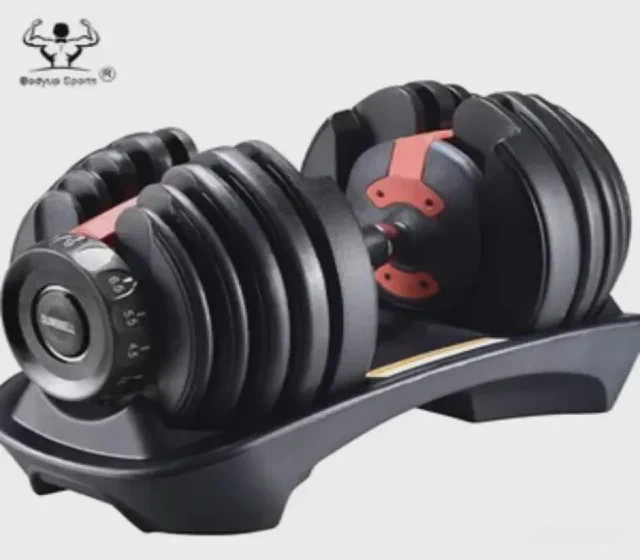
Adjustable Dumbbell 24kg 52.5lb 40kg 90lb Gym Dumbbell Fitness Equipment
- MIC category
- Dumbbell
This supplier-listed adjustable dumbbell is the closest match to the main brief: one dumbbell format intended to cover more than one resistance level. Its listing name references 24kg/52.5lb and 40kg/90lb versions, but the available category information does not confirm the adjustment mechanism, starting weight, increments, dimensions or whether the listing price applies to one dumbbell or a pair. Those details should be verified before purchase. For a beginner, the appeal is clear: one adjustable system can reduce clutter and support progression without adding another pair to the floor.
Best for Beginners who want one expandable dumbbell format and have room for a stable storage base.
- Adjustable format can replace multiple fixed-weight dumbbells.
- The listed range references different capacity options.
- Suitable for comparing progression potential against simpler fixed formats.
Confirm before inquiry: Confirm the exact model, lowest setting, adjustment method, included parts, dimensions and whether the product is sold individually or as a pair.
3. Grip comfort and balance
A small storage footprint does not guarantee a comfortable workout. Adjustable dumbbells can have wider heads, longer handles or unused sections where plates would sit. That may be noticeable during curls, lateral raises, overhead presses and movements where the weight rests near your shoulder.
Look for a handle that allows a full, neutral grip without forcing your wrist into an awkward angle. A textured handle can help, but very aggressive knurling may feel uncomfortable for a new lifter. If you cannot inspect the product in person, confirm the handle diameter, length and head clearance with the supplier.
Fixed dumbbells generally win for natural balance. Their weight is permanently positioned, so the dumbbell behaves consistently from one rep to the next. This is one reason a single fixed pair can be a good starting point, even if it is not the most space-efficient long-term solution.
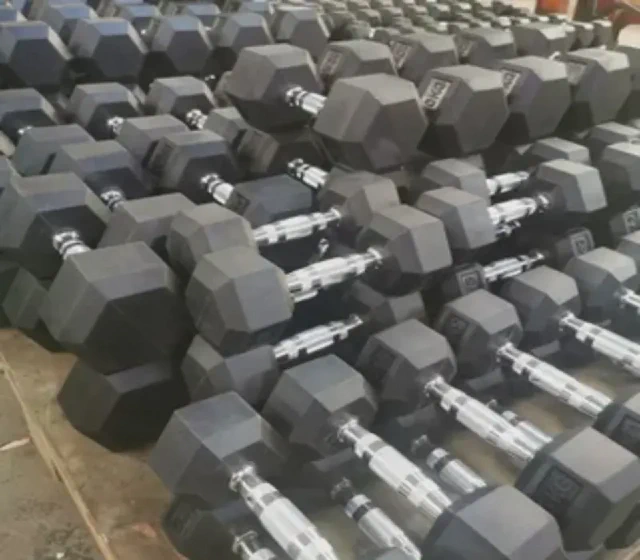
Commercial Gym High-Grade Kg Lb Free Weight Chrome Handle Rubber Coated Black Hex Dumbbell
- MIC category
- Dumbbell
This supplier-listed product is a fixed dumbbell rather than an adjustable system. That makes it straightforward: pick it up and train, with no selector, plates or collars to manage. A hex shape can also be easier to park between sets than a round dumbbell. The limitation is storage. One weight is compact, but building a full-body range means buying and storing multiple pairs. The rubber-coated, chrome-handle description suggests a conventional gym-style format, although comfort, dimensions and coating specifications should be confirmed with the supplier.
Best for Beginners who value immediate use and are starting with one or two fixed weights.
- No adjustment step between exercises.
- Hex shape may help prevent rolling during floor-based workouts.
- Traditional handle-and-head layout is easy to understand.
Confirm before inquiry: It does not provide adjustable resistance by itself, so a wider training range will require additional dumbbells.
4. Starting weight and useful increments
Do not choose a set only because its maximum weight looks impressive. Beginners need a genuinely manageable first setting for movements such as shoulder raises, triceps extensions and controlled presses. They also need small enough jumps to progress without suddenly making an exercise too difficult.
A full-body beginner session might include a goblet squat, Romanian deadlift, one-arm row, floor press, overhead press and suitcase carry. The heavier lower-body movements may eventually need more resistance than curls or raises. A set with a broad range is helpful, but only if its lowest setting is practical and its increments are not too large.
The approved adjustable listing below references multiple capacity versions in its product name. That does not confirm the precise settings, so ask for the full weight table before ordering.
5. Fixed sets versus adjustable pairs
Fixed dumbbells are the easiest to understand. There is no adjustment, no base and no mechanism to maintain. They can be especially good for a beginner who wants short sessions with one or two weights. Hex heads are also useful when you need to put the dumbbells down during floor exercises.
The drawback is expansion. If you begin with a light pair and later add heavier weights, the collection grows quickly. A vinyl-dipped set may look tidy and feel approachable, but it still needs a place for every dumbbell.
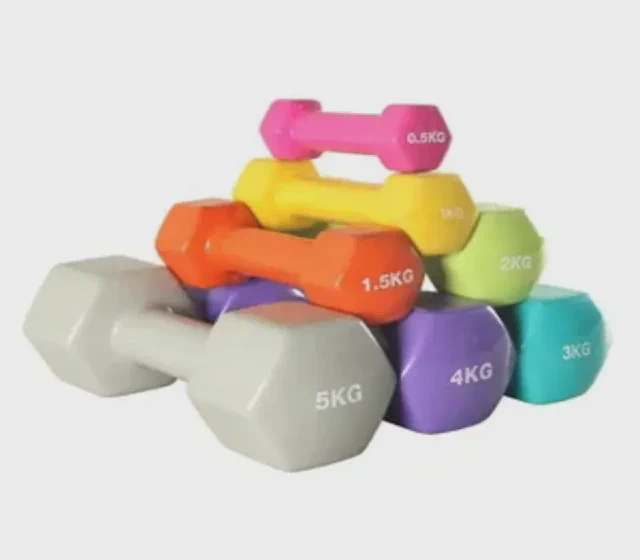
Sport Vinyl Dipped Dumbbell Set Colorful Hex Hand Weight Hex Dumbbell
- MIC category
- Dumbbell
This supplier-listed set is another fixed-weight option, not an adjustable dumbbell. Its vinyl-dipped, colourful hex format may suit beginners who want a visually organised selection for lighter exercises such as raises, mobility work and higher-repetition circuits. Fixed weights are quick to use and do not need a locking mechanism, but a set still occupies more shelf or floor space than one adjustable pair. The listing information supplied here does not state the number of dumbbells, weight range, handle dimensions or storage case, so those points matter before treating it as a small-room solution.
Best for Beginners focused on light workouts who prefer ready-to-use weights over adjustment mechanisms.
- Fixed weights require no setup during a workout.
- Hex heads can be easier to place securely on the floor.
- A set may cover several light exercises without changing plates.
Confirm before inquiry: Check the set contents and total storage footprint; a fixed set can become bulky as more weight options are added.
The easiest setup for a small-room routine
For most beginners, choose an adjustable pair with a stable base, a simple dial or pin adjustment and a low first setting. Keep it beside a clear patch of floor, with a mat underneath if appropriate. Before your first workout, practise changing the weight while the dumbbells are unloaded or set very light. Learn where the locking parts engage, and make sure both dumbbells show the same setting when you are training symmetrically.
If you prefer the least possible setup, start with one fixed pair and build consistency before buying more equipment. A fixed option is also sensible if you mainly perform one exercise style or have no need to progress across many weight levels.
For a small room, the best equipment is not necessarily the most advanced. It is the format that fits your storage space, gives you a comfortable grip and makes the next workout easy to begin. Adjustable dumbbells usually win on space and progression; fixed dumbbells win on simplicity and immediate handling.
Health note: strength training can be modified for different abilities, but equipment should be used with controlled technique and within your current capacity. Stop if you feel sharp pain, and seek advice from a qualified health professional if you have an injury, medical condition or concerns about starting resistance training.
This article offers general information, not medical advice. Adjust activity to your experience and seek qualified guidance when needed.
FAQ
Are adjustable dumbbells practical for a small apartment?
Yes. One adjustable pair can replace several fixed-weight pairs and is usually easier to store. The trade-off is that you need a stable tray or floor space for changing weights, and some designs feel bulkier than traditional dumbbells.
What is the easiest adjustable dumbbell design for a beginner?
A dial or selector-pin design is generally the simplest for beginners because the intended weight can be changed without removing several plates. A plate-and-collar system can also work well, but it requires more handling and careful tightening.
What starting weight should a beginner choose?
Choose a set that allows controlled repetitions for presses, rows, squats and lunges without straining. A light starting option is useful for raises and smaller-muscle exercises, while a wider range gives more room to progress. If possible, check the smallest available setting and the size of each weight jump before buying.
Are adjustable dumbbells comfortable to use?
It depends on the design. A narrow handle and balanced plates feel closer to a fixed dumbbell. Selector-based models may have wider heads or unused space around the handle, which can affect wrist position during curls, presses and exercises where the dumbbell rests near the shoulder.
Can adjustable dumbbells be stored under a bed?
Some low-profile models can, but storage height must be checked rather than assumed. Measure the clearance, include any tray or base, and make sure the dumbbells can be removed without dragging metal across the floor.