Adjustable vs Fixed Dumbbells for Small Apartments: Which Is Easier to Start With?
A practical comparison of selector, spin-lock and fixed dumbbells for beginners who need to train in a small apartment without filling it with equipment.
For most beginners choosing between adjustable vs fixed dumbbells for small apartments, a compact quick-adjust selector pair is easier to live with long term. It gives you several usable weights without a rack taking over the room. But “easier to start with” is not always the same as “most compact.” If you want the least setup and expect to train with only light-to-moderate loads, two or three fixed-weight pairs can be more intuitive, faster and less fussy.
The useful choice is not adjustable versus fixed in the abstract. It is which format removes the biggest barrier between you and three weekly workouts: lack of storage, slow weight changes, uncomfortable handles, noise concerns or uncertainty about progressing.
Start with your apartment, not the maximum weight
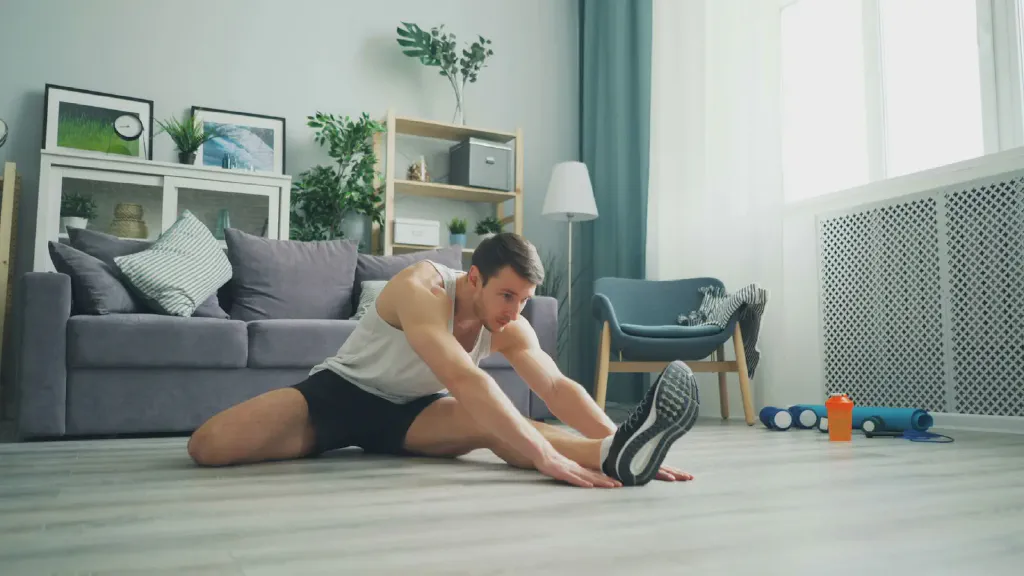
Measure the place where the dumbbells will live before comparing weight ranges. In a small apartment, you need more than a clear patch of floor for exercise. You also need a safe storage spot, enough room to pick weights up without twisting awkwardly, and a plan for putting them down quietly.
A complete fixed set grows quickly. Even a modest run of pairs for presses, rows, squats and arm work needs a rack, shelf or a carefully managed corner. A single pair of adjustables normally occupies far less permanent space because unused weight is stored in its tray or on the handle. That is the central advantage.
However, compact does not automatically mean convenient. Some adjustable dumbbells are long, wide or unusually shaped at lighter settings. They may feel different from gym dumbbells during overhead pressing, goblet squats or exercises where the ends touch your body. Before buying, check the dumbbell’s overall dimensions at both the lightest and heaviest settings, not just its stated weight range.
Selector-style adjustable dumbbells: best all-rounder for tight storage
Selector dumbbells use a dial, pin or similar locking mechanism. Put the handle in its cradle, choose a load, lift it out and the unwanted plates stay behind. For a beginner training in a studio or one-bedroom apartment, that is often the cleanest route to progressive overload: use a manageable weight now, then move up in small steps when repetitions become consistently comfortable.
They are especially practical for full-body sessions. You might use one setting for chest presses, a heavier setting for rows, then a lighter setting for lateral raises without owning six separate pairs. Fast changes help when you prefer circuits or have only 20 minutes to train.
The trade-offs are price, moving parts and handling. Selector designs generally cost more upfront than a basic pair of fixed dumbbells. They need to be returned properly to their cradle before you change weight, and their mechanisms demand more care than a solid fixed pair. Never force a dial, lift a dumbbell that has not visibly locked, or drop it into the tray. Inspect it periodically according to the manufacturer’s instructions.
Noise also needs a realistic view. A selector system can keep unused plates contained rather than scattered around the floor, and a tray can make storage neater. But an adjustable dumbbell can still rattle if it is handled roughly, while a dropped dumbbell can transfer vibration through floors regardless of its format.
Spin-lock adjustable dumbbells: cheapest route to range, slowest route to a session
Spin-lock dumbbells use removable plates secured by threaded collars. They can be an economical way to access a broad range of loads in one compact kit, and you can often make smaller changes than with a selector model if the plate options allow it. When stored well, they occupy much less room than a rack of fixed pairs.
For a beginner on a limited budget, that can be compelling. They work particularly well for simple sessions: complete several sets of a row at one weight, change the plates once, then move to presses. They are less pleasant for rapid circuits, supersets or partner workouts in which the weight changes constantly.
The practical downside is not only time. Plates and collars are separate items that can roll, clink or go missing in a small home. You must tighten collars securely before every set and recheck them if anything shifts. The long ends of some handles can also be awkward on movements where the dumbbells rest near your shoulders or thighs. A small storage bin for collars and a defined plate spot can make this format far more usable.
Neoprene fixed dumbbells: easiest pick-up-and-go option for lighter training
Neoprene and vinyl-coated fixed dumbbells are familiar, compact and uncomplicated. There is no mechanism to learn, no plate changing and no reason to pause mid-workout. Their coating can feel less cold and less intimidating than bare metal, which matters when you are building confidence with your first exercises.
They shine for lighter work: shoulder raises, arm exercises, controlled floor presses, Pilates-style strength sessions and higher-repetition circuits. The issue is that beginners often need different loads sooner than expected. A weight that feels challenging for a shoulder raise may be too light for a squat or row. Buy only the few pairs that solve your current training needs rather than filling a rack pre-emptively.
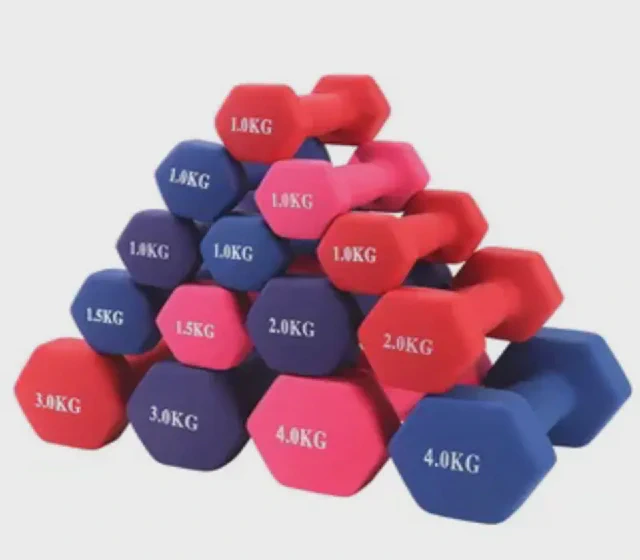
Cheap Factory Direct DIP Coating Dumbbell Solid Iron Anti-Slip Matte Hex Vinyl Dipped Dumbbell Hand Weights Small MOQ Wholesale
- MIC category
- Dumbbell
The supplier listing identifies this as a solid-iron, matte vinyl-dipped hex dumbbell with an anti-slip finish. Vinyl- or neoprene-style fixed dumbbells can make an approachable first set for mobility work, light strength training and higher-repetition sessions. Their limitation is progression: once a weight becomes easy, you need another pair rather than simply turning a dial or adding a plate.
Best for Light home workouts, rehabilitation-style movements only when professionally advised, and beginners who prefer a softer-feeling coated surface.
- Supplier listing describes a vinyl-dipped matte coating
- Hex profile can help prevent rolling
- Fixed weights allow immediate exercise changes
Confirm before inquiry: Coated finishes vary in feel, odour and durability across products. Check the listed weight range and product specifications before ordering, especially if you plan to progress beyond light loads.
Rubber hex fixed dumbbells: traditional feel with the clearest upgrade path
Rubber hex dumbbells are the classic practical choice. They are quick to grab, generally stable on the floor because of their shape, and familiar for nearly every basic dumbbell movement. For many people, they feel more natural than an adjustable system because their length and balance do not change as weight changes.
They are also a sensible way to build a set slowly. Start with a pair that supports upper-body pushing and pulling, plus a heavier option only if you need it for lower-body movements. Add another pair when your training shows a genuine gap. This avoids turning an apartment corner into a permanent rack of weights you rarely touch.
Rubber coating may soften the contact between the dumbbell and a protected floor, but it is not permission to drop weights. Use a firm exercise mat, lower dumbbells under control and avoid placing them directly on delicate flooring.
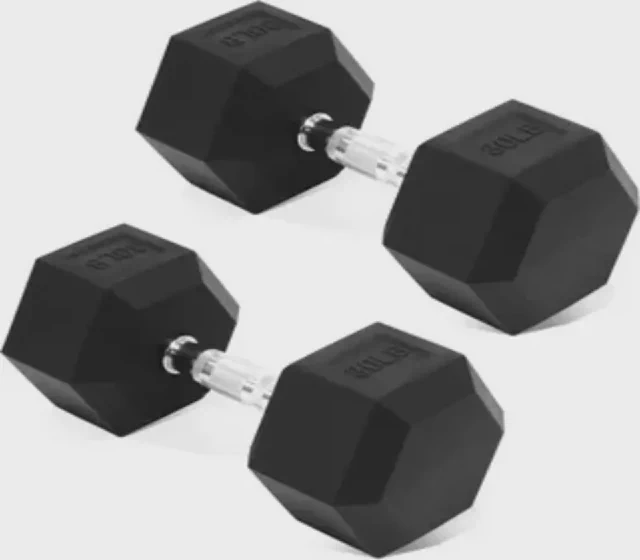
Fitness Training Dumbbell Home Gym Hex Dumbbell Set Rubber Coated Weight Lifting 10kg 20kg 50kg Gym Dumbbell
- MIC category
- Dumbbell
This supplier listing presents a rubber-coated hex dumbbell format for home-gym training. Rubber-coated hex pairs can suit an apartment lifter who wants the familiar balance and quick handling of conventional dumbbells, but prefers a more floor-conscious exterior than uncoated metal. They still need deliberate handling: rubber reduces direct contact harshness, not the impact and vibration produced by a dropped weight.
Best for People who prefer traditional dumbbell handling and plan to add only the pairs they genuinely outgrow.
- Supplier listing describes rubber-coated hex dumbbells
- A fixed pair is fast to move between exercises
- Hex ends provide a more secure resting shape than round dumbbells
Confirm before inquiry: Supplier-listed weight references do not tell you which pairs are included or suitable for a beginner. Buy or source only the increments you can store and expect to use.
Grip comfort matters more than it first appears
A beginner can make most strength exercises harder simply by holding the weight too tightly or allowing the wrist to bend. Look for a handle that feels secure without forcing your hand open. Neoprene and vinyl handles may feel comfortable for lighter loads, while metal knurling can offer a more secure hold once hands get sweaty. Aggressive knurling, though, can feel abrasive during high-repetition sessions.
Fixed hex dumbbells give you a consistent handle and balance every time. Adjustable designs vary more: some have conventional straight handles, while others are block-shaped or become longer as more plates are selected. If grip comfort, wrist sensitivity or hand size is a concern, trying a similar format in person is worthwhile where possible.
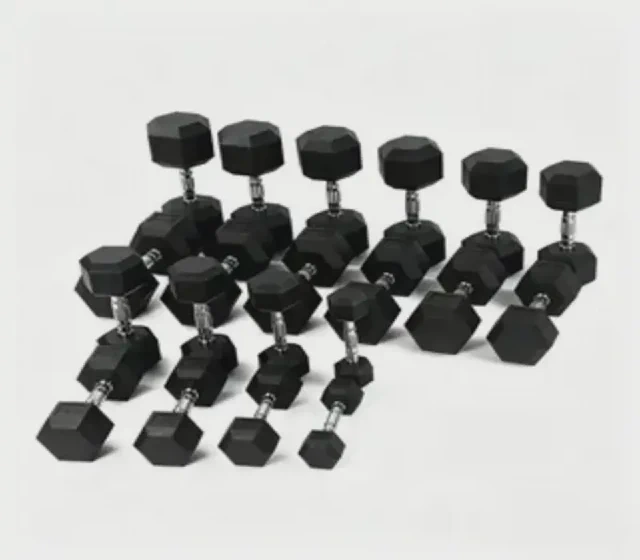
Anti-Roll Hex Dumbbells with Non-Slip Knurled Handles, Beginner-Friendly & Secure Grip
- MIC category
- Dumbbell
This supplier listing describes anti-roll hex dumbbells with non-slip knurled handles. The hex shape is the key practical feature for apartment training: it is less likely to roll away when placed beside a mat or bench. Fixed hex dumbbells are ready as soon as you pick them up, making them a straightforward option for beginners who value a low-friction routine over having many weight choices in one product.
Best for Beginners who want dedicated weights for basic presses, rows, squats and carries without adjustment steps.
- Hex-shaped ends are intended to limit rolling
- Supplier listing describes knurled, non-slip handles
- Fixed-weight format needs no plates, collars or selector mechanism
Confirm before inquiry: This is a supplier-listing product, not an Adore Sport hands-on review. Confirm the available weight options, handle diameter, coating and minimum order details directly with the supplier.
A beginner-friendly progression plan
Your first purchase does not need to cover every possible exercise forever. Choose a setup that lets you make gradual progress for the next several months. A helpful starting target is to perform roughly 8 to 15 controlled repetitions for main movements, stopping before form breaks down. When you can complete the top of your chosen repetition range for all planned sets with good control, increase the load by the smallest available step or add repetitions, depending on your equipment.
Selector systems make this simple when their increments are small enough. Spin-lock sets can be flexible but take longer to change. With fixed dumbbells, you may progress by adding reps, slowing the lowering phase, using one arm at a time, or buying the next pair when those options no longer create enough challenge.
The practical verdict
Choose selector-style adjustable dumbbells if storage is your main problem, you want several exercises from one pair, and you can afford a reliable system with increments that suit you. Choose spin-lock adjustables if budget matters most and you are content with slower, more deliberate workouts. Choose neoprene or vinyl fixed pairs if you want light, immediate, low-complexity training. Choose rubber hex fixed dumbbells if you value traditional handling and can add only a few pairs over time.
For apartment living, the winning setup is usually modest: a compact adjustable pair or two carefully chosen fixed pairs, a mat and a habit of controlled movement. Consistency will do more for your strength than owning a larger collection of weights.
Health note: Strength training should not cause sharp pain, dizziness, chest pain or unusual shortness of breath. Stop if symptoms occur and seek appropriate medical advice. If you are new to exercise, returning after injury, pregnant, or managing a health condition, consult a qualified healthcare professional or fitness professional for individual guidance.
This article offers general information, not medical advice. Adjust activity to your experience and seek qualified guidance when needed.
FAQ
Are adjustable dumbbells worth it in a small apartment?
Usually, yes, if you expect to need more than two or three weight options. One adjustable pair can replace several fixed pairs and is easier to store in a cupboard, under a bed or against a wall. Choose a model with weight increments that suit your current strength and likely next steps.
Are fixed dumbbells better for beginners?
They can be. Fixed dumbbells are immediately understandable, quick to use and often feel more balanced than adjustable designs. A small set is a particularly good choice when you mainly want light-to-moderate workouts and do not mind adding another pair later.
Which dumbbells are quieter for apartment workouts?
The quietest setup is the one you do not drop. Rubber-coated fixed hex dumbbells can be less harsh on floors than bare metal, while some selector adjustable systems have cradles that keep spare weight contained. In every case, use a dense exercise mat, set weights down rather than dropping them, and keep workouts away from sleeping or shared-wall areas where possible.
What weight should a beginner start with?
Choose a load that lets you make smooth, controlled repetitions while keeping one to three repetitions in reserve. You may need different weights for different movements: rows and lower-body exercises commonly use more load than shoulder raises or pressing. If you are unsure about technique, pain, injury or a health condition, seek guidance from a qualified fitness professional or clinician.
Do spin-lock dumbbells take too long to adjust?
They can slow down circuit-style sessions because collars must be loosened, plates removed or added, and collars tightened again. They are less disruptive in straightforward workouts where you complete all sets of one exercise before changing weight.